Cell Organelle Notes
Thursday, November 21, 2013

Wednesday, October 30, 2013
Ecology Study Guide 2
This study guide is due FRIDAY (November 1).
- Mutualism - Both organisms benefit from the relationship.
- Commensalism - One organism benefits and the other does not benefit and is not harmed.
- Parasitism - One organism benefits while the other is harmed.
- Whale and Barnacle; Eyelash Mite and Humans; Sea Cucumber and Fish
- Birth Rate, Death Rate, Emigration, Immigration
- Katrina moved from San Diego to San Jose. She emigrated from San Diego. She immigrated to San Jose.
- The squirrel would eat more producers. Competition among the species would increase.
- Water, Carbon, Nitrogen, Phosphorus
- Bacteria
- Urine and Decomposition
- Animals and Plants that lived millions of years ago.
- solar, wind, water
- coal, oil, natural gas
- Due to technology, we are able to create more food (resources) than ever before. This allows us to support more living things.
- Agriculture, building cities, transportation, industries
- Often time it's inconvenient and costly
- Global warming occurs when the atmosphere thickens due to increased carbon emissions (from transportation and industry) This thicker atmosphere traps the heat from the sun and causes the earth to heat up.
- Primary succession begins on bare rock
Thursday, September 26, 2013
Ecology (Test 1) Study Guide Answers
- Individual - one organism; Population - a group of the same organism; Community - all living (biotic) factors in an area; Ecosystem - all the living and nonliving (abiotic) factors in an area; Biome - similar ecosystems (example: desert, tundra, rainforest); Biosphere - where all life exists on earth.
- (we'll go over this in class)
- (we'll go over this in class)
- population, abiotic factors, ecosystem, biosphere, biotic factors
- A food web shows ALL of the feeding relationships within an ecosystem. A food chain only shows a partial (linear) pathway of energy.
Predator Prey Relationship
- Increasing
- Increasing
- As the moose population increased, there was more food available for the wolves which in turn resulted in the increase of the wolf population.
Sunday, September 8, 2013
Unit 1 Study Guide Answers
- Hair is tied back
- Closed toed shoes
- No loose clothing
2.
- Run water over your skin for at least 5 minutes.
3. Gram
4. Meter
5. Liter
6. 0.00352 km
7. 24L = 24 L (this was a typo - sorry!)
8. a. 1 cm
b. 1 KL
c. 10 g
9. a. coffee
b. time to complete problems
c. group b (no special treatment)
d. they complete the same problems, same age, same level of math
10. a. Does drinking milk affect growth rate?
b. Milk causes increased growth.
c. 10 randomly chosen babies with the same birthdate. After they turn 5 years old, Group drinks 2 cups of milk every day. Group B drinks 2 cups of water instead. Measure growth after 10 years.
11. cohesion (water sticking to itself)
12. high specific heat (water's ability to absorb heat)
13. adhesion - water sticking to other molecules; cohesion - water sticking to other water molecules.
Friday, May 31, 2013
2nd Semester Study Guide Answers
1. Differentiate between
a. Homozygous & Heterozygous - Homozygous 2 copies of the same allele; Heterozygous 2 different copies of the allele
b. Dominant & Recessive - Dominant, usually a capital letter always shows up when present; Recessive, usually a lower case letter, only shows up when there are two copies of it
c. RNA & DNA - DNA has two strands, thymine (T), and deoxyribose, RNA has one strand, uracil (U), and ribose
d. Genes & alleles - genes - DNA that codes for a physical trait; alleles - different forms of a gene
e. Haploid & diploid - Haploid - sex cells, cells with one copy of chromosomes; Diploid - body cells, cells with 2 copies of chromosomes
f. Transcription & translation - transcription mRNA copying DNA; translation - mRNA translated into amino acids
g. positive feedback & negative feedback - positive feedback - brain pushes body farther away from normal before going back; negative feedback - brain brings body back to normal right away
h. arteries & veins - arteries bring blood away from the heart; veins bring blood back to the heart.
2.
a. Homozygous & Heterozygous - Homozygous 2 copies of the same allele; Heterozygous 2 different copies of the allele
b. Dominant & Recessive - Dominant, usually a capital letter always shows up when present; Recessive, usually a lower case letter, only shows up when there are two copies of it
c. RNA & DNA - DNA has two strands, thymine (T), and deoxyribose, RNA has one strand, uracil (U), and ribose
d. Genes & alleles - genes - DNA that codes for a physical trait; alleles - different forms of a gene
e. Haploid & diploid - Haploid - sex cells, cells with one copy of chromosomes; Diploid - body cells, cells with 2 copies of chromosomes
f. Transcription & translation - transcription mRNA copying DNA; translation - mRNA translated into amino acids
g. positive feedback & negative feedback - positive feedback - brain pushes body farther away from normal before going back; negative feedback - brain brings body back to normal right away
h. arteries & veins - arteries bring blood away from the heart; veins bring blood back to the heart.
2.
- camouflage
- padded feet for running
- muscular build to hunt
3. genetic, population, time
4. variation creates competition. without variation, there would be no competition for survival
5. Sam and his friends have long necks due to their genes. Because of that, they ate better than other tortoises and passed on their genes.
6. 46
7. 2
8. 75%
9. 50% (it's always 50%)
10. A trait that is on the X-Chromosome
11. colorblindness, hemophilia
12. 0%, 0%
13. a. Red; b. red & white; c. orange (or any other color that is not red or white)
14. (ask Mrs. Sohn in class)
15. half of the original is saved to make the new strand
16. DNA - ATCG; RNA- AUCG
17. A-T; C-G
18. mRNA
19. tRNA
20. a. GCG ATA CTC AAT; b. TAC GCA CTA GCT
21. a. UCC CCG GGA AAU; b. GAU AGU CUU GGA
22. 3 bases that code for an amino acid
23. 15
24. C, B, D, A
25. dendrites receive signal from another neuron;
26. holds the signal inside the axon
27. pain killers block receptors
28. chemicals that are released into the blood stream that cause changes in the body
29. both are involved in communication inside the body
30. alveoli
31. body is alerting you to danger; example - spider bite that swells and gets increasingly painful
32. 4
33. 1st line of defense - skin, hair, mucous; 2nd line - white blood cell, inflammatory response
34. antibodies pull the different pathogens together to be eaten by a white blood cell
35. they force your body to develop T-cells that are targeted to fight the pathogens
36. HIV - virus infection; AIDS - when T-cell counts drop to a very low level
37. energy available in food
38. Condoms
39. prevent ovulation; prevents fertilized egg from implanting in the uterus
40. (various - HIV, herpes, chlamydia)
Thursday, April 4, 2013
Evolution Study Guide Answers
- Variation
- Natural Selection
- Evolution
- Genes
- Adaptation
- Fitness
- Genetic Drift
- Half-life
- Alelle Frequency
- Speciation
- Founder's Effect
- Relative Dating
- Nocturnal (to avoid heat); No fur (to stay cool); Animals are really good at extracting water from food (no need to drink)
- Because the trees were covered in soot, the once favored light moths suddenly stood out against the dark trees. This made them a more likely target for predators. This caused a rapid change in the genes of the moths. More dark genes were now present in the peppered moth population.
- (Left to Right, Top to Bottom): 4, 2, 5, 3,1,6,
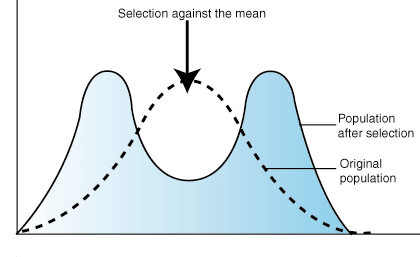
graph shifts to the left.
- 10 g.
- Opposable thumbs, large brains compared to body size, binocular vision, bipedalism
- Sexual reproducers produce variation every time they produce offspring (minnows, incest = more disease)

Subscribe to:
Posts (Atom)